Learning More From Less: What Causal Thinking Buys You in Rare Disease Trials

I've sat in enough rooms with sponsors to know how this conversation usually starts. Someone pulls up a phase 2 result, the topline looks good, and everyone relaxes a little too early, because positive data feels like the hard part is over. Anyone who's watched a strong phase 2 or phase 1b fall apart in phase 3 knows better, because a positive result only tells you that something happened. What determines what happens next is understanding why it happened, meaning which covariates or biomarkers were actually driving the treatment effect, and in rare disease, where a program might only ever see its full patient population once, getting that question wrong is a risk that can end the program. That's the question we built PhaseV to answer.
When you only have a handful of patients to work with, every patient, every data point, and every decision has to count. So the question we keep coming back to is one that's simple to ask and hard to answer well: how do you learn more from less?
Correlation tells you what happened. Causation tells you why.
Most predictive models are built to answer a single question, which is what will happen next, by finding correlations between how a patient looks and how they tend to progress. That approach can be useful, but it works as a black box, producing an answer without much reasoning behind it, and the reasoning is usually most of the value, especially in rare disease, where regulators and clinicians are being asked to trust conclusions drawn from a fraction of the sample size they're used to seeing. It also becomes a real liability when a population is heterogeneous, since a model that only correlates outcomes with baseline characteristics has no way to tell whether a patient improved because of the drug, because of the natural course of the disease, or because of noise in a small dataset. A causal model can make that distinction, and getting it right early is often what separates a trial that fails because the drug doesn't work from one that fails because it was tested on the wrong patients. We build what we call glass box models to make that distinction visible, combining mechanistic models of the underlying disease biology and how a drug acts on it with models built specifically to infer treatment effect, so we can isolate what the drug did from what the disease would have done on its own.
ALS is a good illustration of why this matters. It's rare, it progresses quickly, and it's known for being highly heterogeneous, with some patients declining over months and others over years, a spread wide enough on its own to swamp a modest treatment effect in a small trial. A sponsor came to us with a positive phase 2 ALS study and a phase 3 plan already sketched out. We approached the reanalysis in three steps. First, a prognostic model predicted each patient's expected decline based on their control arm trajectory, which cut through a meaningful amount of noise in the data. Second, causal machine learning surfaced a responsive subgroup, essentially separating faster progressors from slower ones, and showed that patients who were less compromised at baseline had a meaningfully higher treatment effect than the trial population as a whole. Third, integrating both models let us re-optimize the phase 3 design around that subgroup, which allowed the sponsor to reduce the required sample size while lifting the trial's probability of success. That distinction is now shaping the pivotal phase 3 design.
The model didn't just predict an outcome, it showed the sponsor what could happen under a different enrollment strategy. That is what separates a result you can merely observe from one you can actually defend.
Designing for ten patients instead of a thousand
Rare disease trials push this even further. In ultra-rare indications an entire program can sometimes involve fewer than ten patients total, and there's no version of the problem where a larger sample smooths out the noise for you. One way to approach that constraint, and an option we think is genuinely underused rather than a default choice, is to let each patient serve as their own control, comparing their post treatment trajectory against their own predicted natural history instead of against a separate control arm.
That's exactly the situation a recent sponsor brought us: a proposed N-of-1 trial enrolling just six patients, with the central question being how to demonstrate efficacy convincingly in a population that small. We built and simulated two independent statistical frameworks to answer it, without picking a favorite going in. A Bayesian hierarchical changepoint model estimates the size of a treatment driven change directly from each patient's trajectory, while a predictive responder model classifies a patient as a responder when their post treatment data breaks outside their own predicted range. At a sample size of six, the changepoint model came out ahead on statistical power at the same false positive rate, and the responder model, while somewhat less powerful, had the advantage of being easy to explain in plain language as the percentage of patients who responded.
Under a well chosen decision threshold and a realistic large effect scenario, that design delivered 82% power and a 9% Type I error rate from six single patient cases.
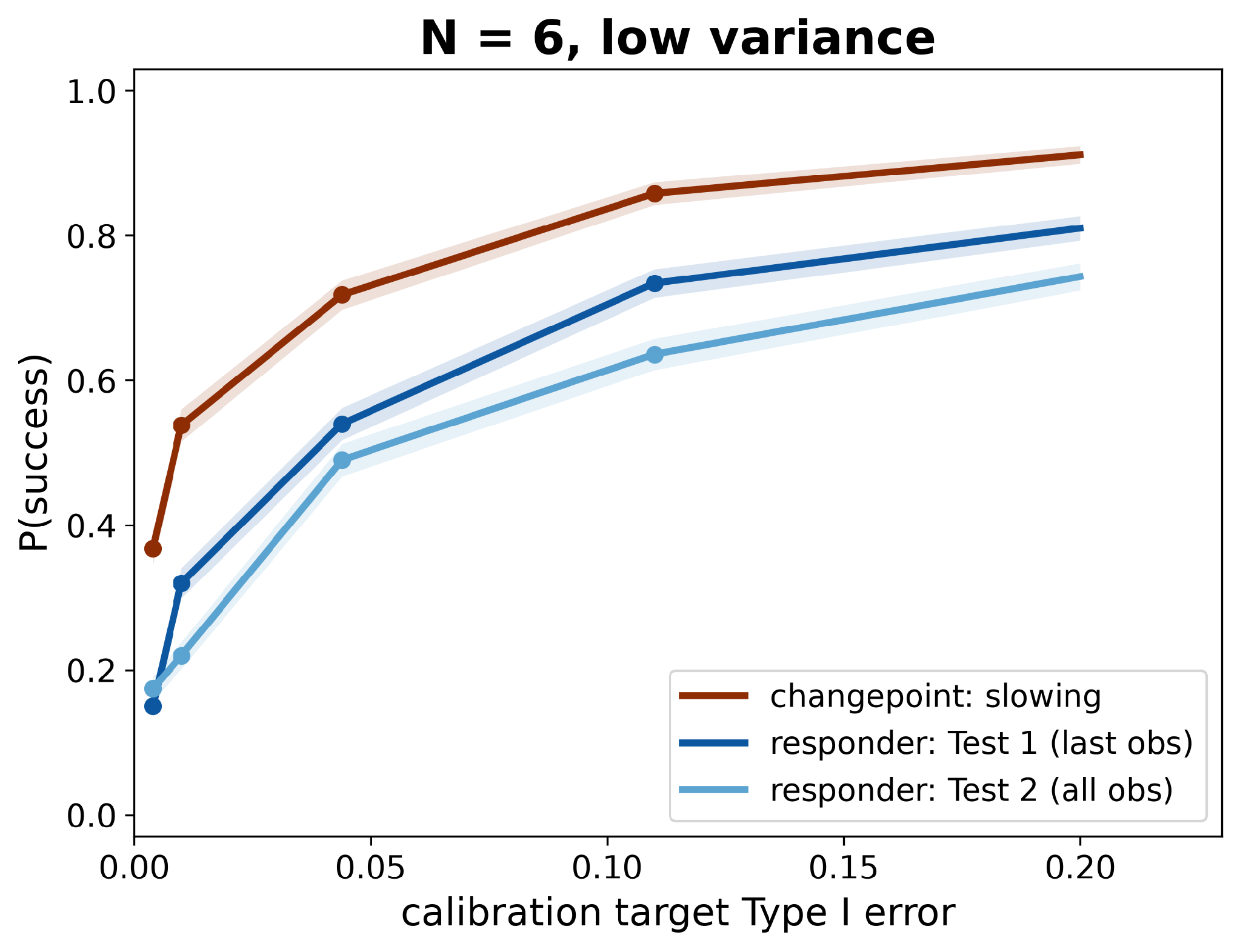
At a sample size of six, the changepoint model consistently delivers a higher probability of success than either version of the responder model, across every calibration target for Type I error tested. This head to head comparison is what let the sponsor choose a method on evidence rather than intuition.
Why verifiability matters most when the sample is smallest
None of this matters if it isn't honest. In a large trial an unverifiable model is mostly a nuisance, because there's enough data around to sanity check it against. In a six patient trial there's no averaging away a wrong assumption, so a sponsor or regulator needs to be able to see how a recommendation was reached rather than simply trust the output. That's part of why we publish our methods for peer review and talk about the cases that didn't work with the same openness we bring to the ones that did, including a recommendation we later realized had been overoptimistic, caught and corrected by an interim analysis before it became a real problem.
The same discipline carries over once a trial moves from design into operations, where rare disease programs run into a different version of the same small numbers problem, since there's no large pool of sites to draw from either. In one program, a sponsor's enrollment target of 48 patients across 40 sites in 10 months had never actually been hit in that indication before, and the risk was visible in the model well before it could have become a missed deadline in the field. Screening more than 3,000 candidate sites against a multi factor framework covering competing trials, site novelty, PI and site experience, and historical performance produced a 60 site shortlist that surfaced 25 novel, high potential sites the sponsor's own list had missed, while flagging likely underperformers already on it. Simulated accrual curves comparing a naive, experience based ranking against the optimized and enriched shortlists showed a meaningfully faster path to target enrollment, delivered as a three week sprint in a new rare indication with limited data to start from. Learning more from less turns out to apply just as much to where a trial finds its patients as to how it analyzes them.
The question worth asking
Underneath the statistics, this work comes down to a resource that no amount of computing power can create more of, which is the patients enrolled in a trial and the time they have. So the question I'd leave you with is the one we ask ourselves at the start of every program.
How could your next trial learn more from less?
References
https://www.phasevtrials.com/post/advancing-oncology-trials-with-covariate-adjustment